Mayans Astronomy Crossword Puzzle (Ya......!)

Once again, it's great to see all of you back here for more Astronomy news, interesting facts and more games!

So, in order to you to have a better understanding of the Mayans Astronomy, I had created an online crossword puzzle using EclipseCrossword software (it is a really good one!). This crossword puzzle is for you to learn the Mayans astronomy in a more interactive and interesting way. So please go to the following link for the crossword puzzle:

http://www2.hci.edu.sg/y09HCI0452/crosswordpuzzle(3).html

Mayans’ Universe (Amazing......!)

Mayans’ Universe


Mayans believed that the world was multi-layered consisting of thirteen levels of the heavens and nine layers of the underworld. The Earth is in the middle and belongs to both the heavens and underworlds.

Layer of heavens:
Description

Layer 1 (Earth)
A large wheel surrounded by the divine water, which is an ocean that extends to the horizon.


Layer 2 (Ilhuicatl metzli)
Moon and clouds reside here


Layer 3 (Citlalco)
Where the fixed stars lie. Also where Citlallicue ("She of the Starry Skirts") lives


Layer 4
Occupied by the Sun (Ilhuicatl Tonatiuh)


Layer 5
Occupied by Venus


Layer 6 (Ilhuicatl Mamalhuazocan)
Occupied by unidentified constellations. This layer is also where comets come from, and where the fire serpents attend to their duty of bringing the sun from the east to the zenith.


Layer 7
The black or green heaven, fierce with winds or storms


Layer 8
The blue heaven, where dust lies


Layer 9 (Itztapal Nanatzcayan)
Where Stone Slabs Crash Together


Layer 10
Represents White


Layer 11
Represents Yellow


Layer 12
Represents Red


Layer 13 (Omeyocan)
Where the dual male-female god, who created space and time, lives.

The nine-layered underworld was where the Milky Way was believed to be. Some Mayans believed that the Milky Way was a road of souls travelling to the underworld (scaring!?), while some, thought that it was the umbilical cord connecting heaven and the underworld to the Earth.

Mayans Astronomy (Continued)

What the Mayans Were interested in?


The Mayans more interested in the:
1) Sun

The sun was associated with Tonatiuh , a red eagle with a large and all-seeing eye. The Mayans managed to calculate the times when the Sun would rise and set. They even determined the length of the solar year to be 365 days. A tropical year is actually 365.2422 days long! How close!


2. The Moon

The Mayans were also interested in the moon. It was represented by a female deity. A waxing (growing) moon resembles a beautiful, ideal woman, while a waning (shrinking) moon was considered to be an old female deity who ruled over childbirth. Around 300 C.E., the Mayans calculated the interval between full moons (lunation). A Mayan astronomer calculated that there was an average lunation of 29.53 days while in Palenque, Mayans calculated that there was an average lunation of 29.53086 days. The actual average lunation is 29.53059 days. The difference is as small as 0.00059 days!

3. Venus

Venus was considered to be connected with the major deity Quetzalcoatl. Quetzalcoatl was said to be an essential god when creating mankind. Venus was also known as “Great Star”. The priest-astronomers determined that it took 584 days for Venus to orbit round the Sun, which was close to the actual period of 583.92 days. It is amazing how the Mayans managed to find out about other planets despite the huge distance between Earth and Venus.

4. Star clusters

Certain star clusters and constellations also held special meaning for the Maya. An example would be the Pleiades star cluster. When it appears in the morning sky around planting time, in late April, the Mayans used it as an indication to start preparing for the planting season. Since they could predict the rising of the Pleiades in connection to the appearance of other constellations on the horizon, they always know when to start preparing.

- Problems with calculations
However, do you know that actually small errors like 0.00059 days off in calculations can cause a calendar to be completely not accurate. A possible effect is that the calendar can be a month off every hundred years. But the Mayans continually update their records and predictions so that their calendar remains accurate throughout the generations.

Mayans Astronomy Introduction (Finally......!)

Hi, all astronomy fans, good to see all of you back, now let us start on the Mayan culture Astronomy......!

Introduction:
Do you know that in the Mayans culture, astronomy was actually done by priests or "ilhuica tlamatilizmatini" ("the wise man who studies heaven"). All the observations were done, only using special buildings as reference points. The Mayans paired certain celestial bodies with a god and thus regard celestial events as an indication of their communication with these gods. Mayans also use to constellations or planets in the sky to indicate the planting season. This ensures that the Mayans will not starve. SMART!


So how did the Mayans exactly make observations in the sky? A common method called the Zenith passage of the Sun is used. Twice a year at noon the sun stands directly overhead in the tropics. The path in which the Sun takes then is called the Zenith passage. Mayans would place a column with exact vertical alignment to the Sun onto the ground or on the roof. When the Sun passes through the Zenith passage above this column, no shadows would be formed. Some Mayans also stay in Vertical Sighting, which are holes in the ground to observe the sky.

Vertical Zenith Sighting Tube

Calculation


After observing, one definitely needs to calculate some figures. On the whole, these calculations were simply done by counting, for instance, the number of lunar revolutions in a certain time period. For more complex calculations, however, mathematics was used.

M.A.Y.A.N.S Simplified Mayans Astronomy Intro Video


Hi, all astronomers! To start on the interesting Mayans astronomy, I had created a short introductory video for you to have at least a idea of what the Mayans Astronomy was like. This video was made with iMovie and this was aimed to give a short preview of the Astronomy in the Mayans times and how it worked. We wanted to make the video as informal as possible, giving it a more "movie-trailer" like effect to further enhance the attractiveness of our project. We got all of the pictures from the internet and added many special effects and even some music! Hope you enjoy our video!

M.A.Y.A.N.S Simplified project product outcome - something new!

Product outcome
Project website ( product outcome)

What a relief! Our project website is finally done! What has seemed like an impossible feat has now become possible. The website now consist of a main page, with our introductory video right in the middle of screen, followed by 4 links at the bottom. Namely :Quiz, Info, Blog, and credits.


I am quite satisfied with the outcome, as i have been working on this product for more than a month, and now, with every thing coming together, the website has truly become educational and interactive ( the main aim of our website) . However, despite me being in a temporary state of euphoria, i still have to get back to work, as the website still has some minor bloopers (eg. spelling error and FTP errors).

Here are some screen shots of our website :

So, all astronomy fans, now let us embark on a new journey to the...... Mayans Astronomy! Ya!!!


Mars now frozen, but when did it have liquid water? (Part 1)

Once again, good to see all astronomy fans here hungry for more astronomy news, updates and interesting facts! Now today, I'm researching about the mysterious red planet - Mars......
As all of you should know, Mars is now frozen, with no single drop of liquid water as water is frozen solid. But there are still some evidences showing that there may have been liquid water on its surface when Mars was young, however, is this TRUE? 

For some contextual knowledge, the average temperature of this Red Planet is actually negative 55 degrees Celsius (-67 F)! So freezingly C...O....COOL! However, do you know that when the temperature rises, the highest recorded temperature is a balmy 20 degrees C (68 F)! During this period, this thick layer of ice turns directly into a gas, skipping the liquid phase entirely because of the low atmospheric pressure.

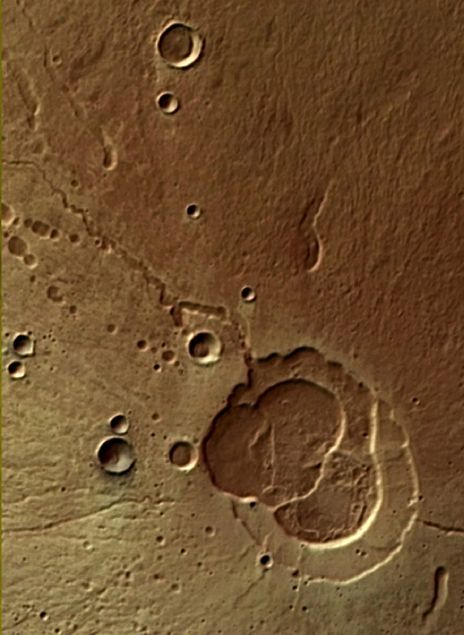
According to scientific research, Mars may have had a thicker atmosphere and liquid water on its surface between 3.5 and 4 billion years ago. Satellites orbiting Mars have also taken images of ancient ocean shorelines, river beds and canyons - which are evidences of the presence of flowing water. In addition, the chemistry of the martian soil also suggests that liquid water may have been present once on the surface. Then if this is true, then perhaps life could have emerged on Mars during this time in its history.


Many scientists think Mars was cold when it was young - cold enough so that surface water should have been frozen solid. One way around this problem is if the chemistry of the water was such that it could remain liquid at lower temperatures. On Earth, the salt in seawater prevents it from freezing at the same temperature as freshwater. For early Mars to be cold but still wet, however, the water would have had to be much saltier than seems likely.

However, there is still another possibility that Mars was actually warmer in the past than colder. At first glance, you may feel that this idea does not make any sense to you, however, think again. You see, the Sun was fainter back then, long ago, so the planet should have been even colder in the past and then gradually warmed up as the Sun grew brighter. But sunlight is not the only way to warm a planet, isn't it?


An atmosphere can also help keep conditions toasty. Okay, just look at Venus, thick greenhouse atmosphere has actually raised its average surface temperature to a searing 464 degrees Celsius (867 F)! So can you see the effects of greenhouse atmosphere on the warming of planet?

Think again, could Mars also once have had a greenhouse atmosphere that warmed the planet enough so it is able to keep water flowing across its surface in the past?

However, some scientists do not think this way. Professor Brian Toon of the University of Colorado had discussed the possibility of a warm and wet Mars at the recent NASA Astrobiology Science Conference in League City, Texas.

"We've spent 30 years on the greenhouse effect and no one has solved the problem in a credible way so far,” noted Professor Toon. “On the greenhouse problem, we're just drifting into deeper and deeper complexity."

Why does the greenhouse climate work so well to heat up Venus but not Mars? The thick clouds of Venus also bounce a lot of sunlight off into space, and that reflection is why we’re not able to see the surface of Venus in the visible light spectrum. One answer is that Venus is much closer to the Sun, so it receives substantially more sunlight than Mars does. According to Toon, another reason is that Mars is little. The lower gravity of a less massive world reduces the rate that air cools with altitude. On Earth this rate is about 10 degrees Kelvin per kilometer, but on Mars the rate is about half that.


“This makes it harder to get a greenhouse effect, giving you less ‘bang for the buck’ for your greenhouse gases,” Professor Toon said. “Mars is hard to warm up because it’s so small.”


Also, Professor Toon believes that, rather than a greenhouse atmosphere keeping Mars warm and wet, the canyons and river beds we see on Mars formed due to periodic asteroid and comet impacts. In this scenario, impacts would have filled the atmosphere with vaporized rock and ice and resulted in several years of rainfall and flooding that created the erosion features on Mars.


“We know the impacts occurred - we can see the craters there,” said Professor Toon. “It's pretty much impossible to avoid there being large amounts of water coming from them.”
 
 
So, as you can see, this is one explanation by Professor Toon on the formation of flowing water on the red planet, Mars. However, you may have different viewpoints and opinions than what you see in this post. So feel free to comment in the discussion forum. Also, you will see another explanation on the formation of flowing liquid water on Mars very soon....... Good Luck!
 

Image resources: