What canyon is larger than the Grand Canyon?

Have you heard about the America's Grand Canyon? But do you know what canyon is actually larger than the Grand Canyon?

The largest canyon is actually on MARS! (COOL......!) The surface of Mars is more stable than the Earth's. Furthermore, there is no rain or running water to wear down the landscape on Mars. Hence, although Mars is only about half the size of the Earth's, it has a volcano which is called Olympus Mons 24 km high - three times as high as Mount Everest!

In addition, it has a great chasm which is discovered by the Mariner 9 space probe and called the Valles Marineris. This is over 4000 km long and four times as deep as America's Grand Canyon. Isn't that shocking!

Let's watch an interesting video on the Mars' Moon! Enjoy!
URL: http://www.youtube.com/watch?v=Al_YHmIXx9Q


* Interesting facts!

Do you know what is so frightening about Mars' Moon? It was told that one night, an American astronomer Asaph Hall got fed up with studying Mars and decided to go to bed. However, his domineering wife bullied him into staying up - and that night was when he discovered Mars' two moons. Mocking his fear of his wife, he then named the two moons Phobos (fear) and Deimos (panic)!

- Do you know why is Mars red?

Mars appears to be red as it is rusty. Its surface contains a high proportion of iron dust and this has been oxidized in the carbon dioxide atmosphere.

Image source: http://www.energie-der-sterne.de/Mars.gif

The birth of the Sun (Interesting......!)

The Sun is an average star, just like countless others in the universe. It formed from gas left behind after an earlier, much larger star blew up and now, in the middle-age, burns yellow and fairly steadily - giving the Earth daylight and remarkably constant temperatures. Besides heat and light, the Sun sends out deadly gamma rays, X-rays and ultraviolet, as well as infraredand radio waves. Fortunately, we are shielded from these harmful rays from the Sun by the Earth's magnetic field and atmosphere.

- Solar eclipse

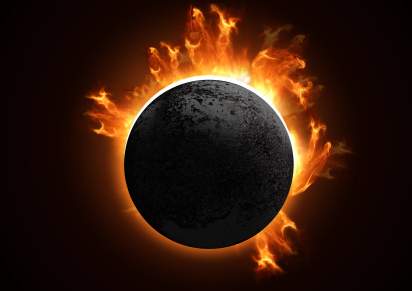
A solar eclipse is when the Moon comes in between the Sun and the Earth, creating a shadow a few hundred kilometres wide on the Earth.


- How big exactly is the Sun?

The Sun is a small to medium-sized star 1, 392, 000 km (0.86 million miles) in diameter. It weighs just under 2000 trillion trillion tonnes.

- What is the Sun's crown?

The Sun's crown is its corona, its glowing white hot atmosphere seen only as a halo when the rest of the Sun's disc is blotted out by the Moon in a solar eclipse.

- How hot is the Sun?

The surface of the Sun is a phenomenal 6000 degree celcius and would melt absolutely anything. But its core is thousands of times hotter at over 16 million degree celcius!


- What makes the Sun burn?

The Sun get its heat from nuclear fusion. Huge pressures deep inside the Sun force the nuclei (cores) of hydrogen atoms to fuse together to make helium atoms, releasing huge amounts of nuclear energy.

- How old is the Sun?

The Sun is a middle-aged star and probably formed about five billion years ago. It will probably burn for another five billion years and then die in a blaze so bright that the Earth will be scorched right out of existence.

- What is the solar wind?

The solar wind is the stream of radioactive particles constantly blowing out from the Sun at hundreds of kilometres per second. (The Earth is protected from the solar wind by its magnetic field, but at the poles, the solar wind interacts with the Earth's atmosphere to create the aurora borealis or northern lights.) 

- What are solar flares?

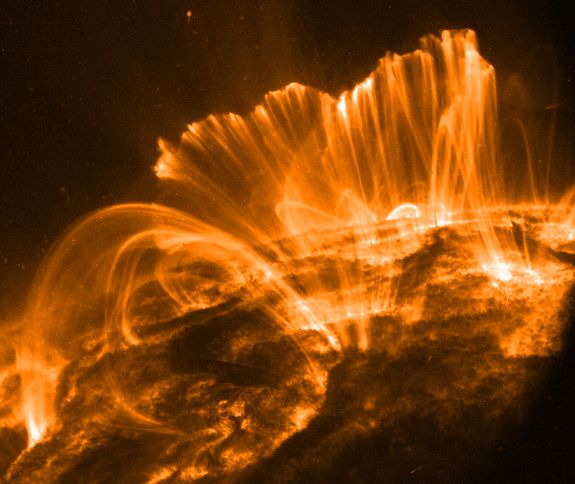
Flares are eruptions from the Sun's surface that fountain into space with the energy of one million atom bombs for about five minutes. (They are similar to solar prominences, the giant flame-like tongues of hot hydrogen that loop 100 000km/60000 miles into space.)


- Sunpots

Sunpots are dark blotches seen on the Sun's surface. They are thousands of kilometres across, amd usually occur in pairs. They are dark as they are slightly less hot than the rest of the surface. As the Sun rotates, they slowly cross its face - in about 37 days at the equator and 26 days at the Poles. The average number of spots seems to reach the maximum every 11 years, and many scientists believe that these sunspot maximums are linked to periods of stormier weather on the Earth.

- Parts of the Sun
Now, let watch an interesting documentary on the formation of the Sun. Enjoy!

What is really Moon (Erm......)

So do you know how does the Moon form?

The Moon is the Earth's natural satellite which has circled around it for at least four billion years. It is actually a rocky ball about a quarter of the Earth's size and is held in its orbit by mutual gravitational attraction. Scientists believed that the Monn formed when early in the Earth's history, a planet smashed into it. The impact was so great and tremendous that nothing was left of the planet but a few hot splashes thrown back up into space. Within a day of the smash, these splashes had been drawn together by gravity to form the Moon.

- Who was the first man on the Moon?

The first men on the Moon were Neil Armstrong and Buzz Aldrin of the US Apollo 11 mission who landed on the Moon on 21 July 1969. (As Neil Armstrong once said, "This a small step for a man, a giant leap for mankind.")

- What are the Moon's seas?

The large dark pitches visible on the Moon's surface are called seas, but in fact they are not seas at all. They are huge plains formed by lava flowing from volcanoes that erupted early on in the Moon's history.

- How long is a Moon month?

It takes the Moon approximately 27.3 days to circle the Earth, but 29.53 days from one full moon to the next as the Earth moves as well. A lunar month is the 29.53 days cycle. Calendar months are entirely artificial.

- What is a lunar eclipse?

As the Moon revolves round the Earth, sometimes it passes right into the Earth's shadow, where sunlight is blocked off. This is a lunar eclipse. So if you look at the Moon during this period of time, you will see the dark disc of the Earth's shadow creeping across the Moon.

- What exactly is moonlight?

The Moon is by far the brightest object in the night sky. However, it does not give off its own light. Hence, it simply reflects off the Sun light to produce moonlight.

- What is inside the Moon?
  • The Moon's surface is covered with a fine layer of dust.
  • The surface of the Moon is pitted with impact craters, obliterated in part by giant ancient lava flows called seas
  • The Moon's mantle is now very cool as compared to the Earth's.
  • The Moon's outer core is probably solid metal.
  • The Moon has an inner core of metal, very much smaller in relation to its size than the Earth's.
  • The Moon has a crust of solid rock thinner than the Earth's - up to 150 km (90 miles) thick on the side away from the Earth.
 - Harvest Moon

The harvest moon is the full moon nearest to the autumnal equinox (when night and day are of equal length). This moon hangs bright above the eastern horizon for several evenings, providing a good light for harvesters.

 - Why does the sea have tides?

The Moon's gravity draws the oceans into an oval around the Earth, creating a bulge of water on each side of the world. These bulges stay beneath the Moon as the Earth spins around and seem to run around the world, making the tide rise and fall as they pass.

- Phases of the Moon:


Now, let watch a video on the formation of the Moon:

How did the Earth begin? (WOW......!)

So do you really know how did our mother Earth form? Or why did it form?

- Formation of Earth

Around four and a half billion years ago, neither the Earth nor any of the other planets existed. There was just this vast dark very hit cloud of gas and dust swirling around the newly formed Sun. Gradually, the cloud cooled down and the gas began to condense into billions of water droplets. Slowly, these droplets then were pulled together into clumps by their own gravity - and they were carried on clumping until all the planets, including Earth, were formed. But it took about another half a billion years before the Earth had cooled enough to form a solid crust with an atmosphere around it.
- Process of the formation of the Earth

As the Earth orbits the Sun, the hemisphere of the planet which faces the Sun experiences summer while the hemisphere facing away from the Sun experiences winter.

- How long exactly is an Earth day?

An Earth day is the time when the Earth takes to rotate on its axis once. The stars come back to the same place in the sky every 23 hours 56 minutes 4.09 seconds (the sidereal day). Our day (the solar day) is 24 hours as the Earth is moving round the Sun and it must turn an extra 1 degree for the Sun to return to the same place in the sky.

- Why does the Earth spin?

The Earth spins as it is falling around the Sun. As the Earth hurtles round the Sun, the Sun's gravity keeps it spinning, just as the Earth's gravity keeps a ball rolling down hill. 

- What is the Earth made of?

The Earth has a core of iron and nickel, and a rocky crust which is made mostly of oxygen and silicon. In between is the soft hot mantle of metal silicates, sulphides and oxides.

- How big exactly is the Earth?

Satellite measurements show it is 40,024 km (24,870 miles) around the equator and 12,578 km (7,927 miles) across. The diameter at the poles is slightly less, by 43 km (26.7 miles).

- Who was Copernicus?

In the 1500s, most people thought that the Earth was fixed at the centre of the universe, with the Sun and the stars revolving around it. However, Nicolaus Copernicus (1473 - 1543) was the polish astronomer who first suggested that the Earth was actually revolving around the Sun and not the other way round.

Here, let watch an interesting video on the birth of the Earth. Enjoy!

Astrology VS Astronomy

After reading about the instruments used in Astronomy, I think you might be interested to know more about another topic which seems to be confused by most people with Astronomy. This term is Astrology (this might be your first time hearing this word, right?).

The word, Astrology, actually comes from the Greek word astron meaning "star" and logy meaning "the science". Astrology is a group of systems, traditions, and beliefs which hold that the relative positions of celestial bodies and related details can provide information about personality, human affairs, and other terrestrial matters. A practitioner of astrology is called an astrologer.

Since Babylonian times, people staring at the night sky were convinced that the regular motions of the heavens were indications of some great cosmic purpose. Priests and philosophers all believed that if they could map the stars and their movements, they could decode these stars and understand the patterns that had an effect on past and future events.

However, there is no evidence to support their belief that stars and planets have any effect on our personalities or our destinies. Astronomers now thnik Astrology is just superstition. However, its original noble motives should not be forgetten. For most of the so-called "Dark Ages", when all pure science was in deep hibernation and the desire to know about the future that kept the science of Astronomy alive.

- Rulership over organs

Until the discoveries of modern medicine, ancient people believed that the body was governed by four main different types of essence which were called "humours". An imbalance in these humours would result in illnesses. Each of the 12 signs of the horoscopes had special links with each of the hmours and with parts of the human body. One example is for a headache due to the moisture in the head (a cold), treatment would be with a drying agent - some plant ruled by the Sun or an "Earth sign", like Virgo -when a New Moon was well placed towards the sign of Aries, which ruled the head.

- Perpetual Calendar

In this calendar, the names for the days of the week show traces of astrological belief - for example, Sunday is the Sun's day, and Monday is the Moon's day. This simple perpetual calendar, which contains small planetary signs next to each day, shows the day of the week for any given date. The user can find out the day by turning the inner dial to a given month or date and reading off the information.


- Examples of zodiacs in Astrology

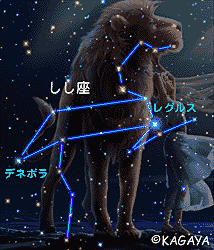
These 19th-century French constellation cards show each individual star marked with a hole through which light shines. Astrologically, each zodiacal sign has its own properties and its own friendships and enemies within the zodiacal circle. Each sign is also ruled by a planet, which similarly has its own properties, friendships, and enemies. So, for example, a person born while the Sun is passing through Leo is supposed to be kindly, like a lion. 

Scorpio, the Scorpion

Most of the constellations are now known by the Latinized versions of their original Greek names. This card shows Scorpius, or Scorpio. This is the sign "through which" the Sun passes between late October and late November. Astrologers believe that people born during this time of year are intuitive, yet secretive, like a scorpion scuttling under a rock.


Cancer, the Crab

Cancer is supposed to be a home-body, like a crab in its shell. These hand-painted cards are collectively known as Urania's Mirror - Urania is the name of the muse of astronomy. By holding the cards up to the light, it is possible to learn the shapes and relative brightness of the stars in each constellation.

References:

Instruments used in Astronomy (COOL......!)

Now that you have learnt the history of ancient Astronomy, I think it is always good for you to know the ancient instruments used in Astronomy. With all the tools of modern technology, it is something hard to imagine how people performed simple functions such as telling the time or knowing where they were on the Earth before the great invention of the clock, maps, or navigational satellites. In ancient times, the only tools available were those provided by the nature.
The astronomical facts of the relatively regular interval of the day, the constancy of the movements of the fixed stars, and the assumption of certain theories, such as a spherical Earth, allowed people to measure their lives. By calculating the height of the Sun or certain stars, the ancient Greek began to understand the shape and size of the Earth. In this way, they were able to determine their latitude. By plotting coordinates against a globe, they could fix their position on the Earth's surface. In addition, by setting up carefully measured markers, or gnomons, they could begin to calculate the time of the day.

* Interesting facts......!
- Measuring the size of the Earth

About 230 BC, Eratosthenes (c. 270 - 190 BC) estimated the size of the Earth by using the Sun. But how......? He discovered that the Sun was directly above his head at Syene in Upper Eypt at noon on the summer solstice. In Alexandra, directly north, the Sun was actually about 7 degrees from its highest point (the zenith) at the summer solstice. Since Eratosthenes knew that the Earth was spherical (360 degrees in circumference), the distance between the two towns should be 7/360 ths of the Earth's circumference.

- Ancient Sundial

Very early on, people realized that they could keep time by the Sun. Simple sundials like this allowed traveller or merchant to know the local time for several different towns during a journey. The altitude of the Sun was measured through the sight holes in the bow and stern of the "little ship". When the cursor on the ship's mast was set to the correct latitude, the plump bob would fall on the proper time.

- How a sundial works?

As the Sun travels across the sky, the shadow which it casts changes in direction and length. A sundial works by setting a gnomon, or "indicator", so that the shadow which the Sun casts at noon falls due north/south along a meridian. (A meridian is an imaginary line running from pole to pole and another for it is a line of longitude.)

The hours can then be divided before and after the noon mark. Hence, the terms "a.m." and "p.m." for morning and night actually originated from the Latin words meaning before and after the Sun passes the north/south meridian. So "a.m." actually refers to "ante meridiem" and "p.m." refers to "post meridiem"!

- Cruciform sundial

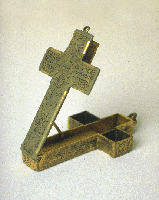
Travelling Christian pilgrims often worried that any ornament might be considered a symbol of vanity. They solved this problem by incorporating religious symbolism into their sundials. This dial, which is shaped in the form of a cross, provided the means for telling the time in a number of English and French towns.
- Celestial Globe

The celestial globe records the figures and stars of all the constellations against a grid of lines representing longitude and latitude. During the 17th and 18th centuries, all ships of the Dutch East India Company (E.I.C) were given a matching pair of globes - terrestial and celestial. Calculations could be made by comparing the coordinates on the two different globes. In practice, however, most navigators seemed to be using flat sea-charts to plot their journeys instead of celestial globes.

- Backstaff

The backstaff allowed a navigator to measure the height of the Sun without having to stare directly at it. The navigator held the instrument so that the shadow cast by the shadow vane would fall directly on to the horizon vane. Moving the sight vane, the navigator lined it up so he could see the horizon through the sight vane and the horizon vane. By adding together the angles of the sight and shadow vanes, the navigator could calculate the altitude of the Sun, from which he could determine the precise latitude of his ship.


Image source:

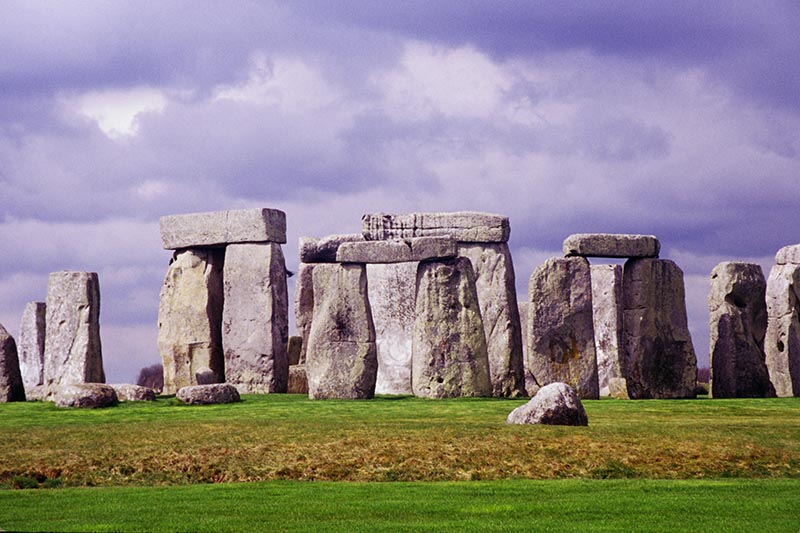
More about Stonehenge

Stonehenge, constructed between 3100-2000 BCE on England's Salisbury Plain, may have been a Stoneage astronomical site (observatory is too strong a word), at least in part. Certainly the alignment of the "heelstone" with the rising Sun on Midsummer's Day (June 21, the Summer Solstice) represents a true astronomical alignment, and many other Megalithic sites have similar alignments. In Stonehenge Decoded, astronomer Gerald Hawkins argued that there exist a large number of astronomical alignments, though further study suggests that many of these are fortuitous.
Cosmologist Fred Hoyle has suggested that Stonehenge may have been used to keep track of the solar-lunar eclipse cycle. Far outside the still partially standing ring of Sarsen Stones is a ring of 56 holes, known as the Aubry holes. Hoyle has noted that movement of a marking stone by 3 positions each time the Sun rose over the heelstone (or by one position three times yearly) would complete a circle in 18.67 years -- approximately the period for the "nodes", the intercepts of the lunar and solar paths in the sky, to complete a cycle. Certainly ritual use of Stonehenge would have been more important that its astronomical functions and much of this interpretation must remain speculation.

- Recording Sun's movements

Even though the precise significance of the standing stones at Stonehenge remains the subject of debate, it is clear from the arrangement of the stones that were erected by pre-historic people specifically to record certain celestial events, such as the summer and winter solstices and the spring and autumnal equinoxes. Although Stonehenge is the best known of the ancient megalithic monuments (those made of stone in pre-historic times), the sheer number of similar sites throughout the world underlines how many pre-historic people placed an enormous importance on recording the motions of the Sun and the Moon.


- Parts of the Stonehenge

As seen in the above diagram, there is an avenue leading to the centre of the Stonehenge. Along the avenue, there is also heel stone which marks the original approach to the Stonehenge. After passing the heel stones, you will see slaughter stone which actually forms a ceremonial doorway for the Stonehenge. Around the Stonehenge, there are also some station stones with aubrey holes which are round pits that were part of the earliest structure. In addition, there is a barrow in it and a circle of Sarsen stones with lintels in the centre of the Stonehenge. In the circle, there is an altar stone which is found in the middle of it.


References: