What are GIANT planets?

After learning what are inner planets, do you know what exactly are giant planets?

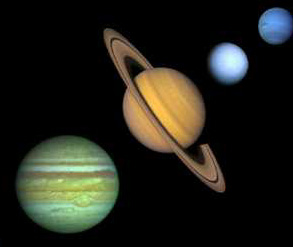
 Jupiter and Saturn which are the fifth and sixth planets out from the Sun are the giant planets in the solar system. Do you know that Jupiter is actually twice as heavy as all the other planets put together!


In addition, Jupiter is also 1300 times as big as the Earth. Hence, it is the largest planet in the solar system. Jupiter also has a ring system like Saturn but much, much smaller. High-speed winds whirl round Jupiter's surface, creating bands of cloud in the atmosphere.

* Interesting facts!


Do you know that Jupiter actually has 16 moons - 4 big ones which are discovered by Galileo as long ago as 1610 and thus these four moons are named after him the Galilean moons, and there are also 12 small ones.


- What is Jupiter's red spot?


The Great Red Spot or GRS is a huge swirling storm in Jupiter's atmosphere 40000 km across that has gone on in the same place for at least 330 years.


- Do you know how fast does Jupiter revolve on its axis?


Jupiter revolves on its axis faster than any other planets. Despite its huge size, it turns right round in just 9.8 hours, which means the surface is actually moving at an incredibly speed of 45 000 kph!


- Could you land on Jupiter?


Based on scientific research, even if your spaceship could withstand the enormous pressures, there is no surface to land on as the atmosphere merges unnoticeably into deep oceans of liquid hydrogen.

Now, let's watch an documentary on Jupiter. Enjoy!


- Saturn
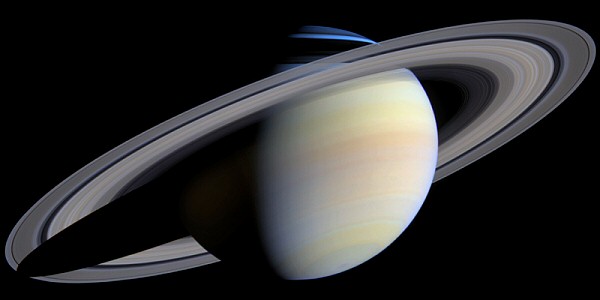
Saturn is almost as big as Jupiter. Unlike the inner planets, both Jupiter and Saturn are made largely of Hydrogen and Helium and only their very core is rocky. This does not mean that they are vast cloud balls. However, it tells us that the enormous pressure of gravity means the gas is squeezed until it becomes liquid and even solid.

Saturn may be very big but because that it is mainly made of liquid hydrogen, it is also remarkably light with an unbelievable mass of 600 billion trillion tonnes! So this means that if you can find a big enough bathtub, Saturn would float on it!

Saturn also has rings which are made of billions of tiny chips of dust and ice - few of them are even bigger than a refrigerator and most the size of ice cubes. These rings are extremely thin - no more than 50 m deep, yet they stretch all the way above Saturn's clouds, and 7000 km high and over 74000 km out into the space. Do you know that one of Saturn's rings is actually as thin as a piece of tissue paper being stretched over a football pitch!


- How windy is Saturn?


Saturn's winds are actually even faster than Jupiter's and roar round the planet up to an amazing speed of 1800 kph. However, Neptune's wind speed is fastest!


- Do you know how many moons does Saturn have?


Saturn has at least 18 moons including Lapetus which is black on one side and white on the other side. In addition, one of its moons which is Enceladus is actually covered in shiny beads of ice and shimmers like a cinema screen.


- The Cassini division!


Saturn's rings occur in broad bands labelled with the letters A to G. In 1675, the astronomer Cassini spotted a dark gap between the rings A and B which is now called after him, the Cassini division.


Here is an interesting documentary on Saturn. Enjoy!

What are inner planets?

So do you know what are inner planets?

The inner planets are actually the four planets which are nearest to the Sun. These planets are the Earth, Mars, Venus and Mercury. As pluto has been considered as dwarf planet, it is now not included in the inner planets. These planets are planets made of rock, unlike the bigger planets further out which are made mostly of gas.

As these inner planets are mainly made of rock, they have a hard surface which allow a spaceship to land on. This is why sometimes these inner planets are called terrestial (earth) planets. They all have a thin atmosphere, but each of them is very different from one another.

- Venus

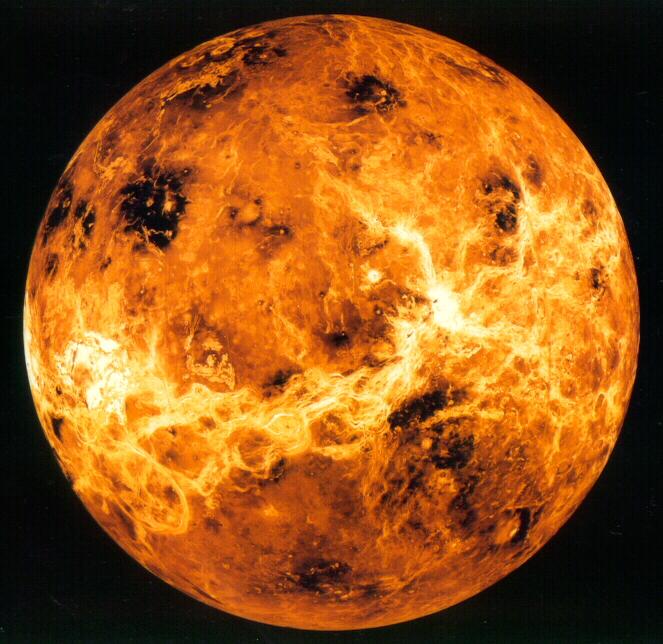
Venus is a soft pinkish white planet with no features visible on the surface through its thick atmosphere.

Venus's atmosphere would be very DEADLY for the humans. It is very deep so the pressure on the ground is huge. In addition, it is mainly made of poisonous carbon dioxide and is also filled with clouds of sulphuric acid.

- Do you know why is Venus called the Evening Star?

Venus reflects sunlight so well that it shines so brightly like a star. However, because it is qutie close to the Sun, we can only see it in the evening, just after the Sun sets. In addition, we can also see it just sometime before sunrise.

Here are some interesting documentaries on the deadly planet Venus. Please take some time to watch it. Enjoy!
URL: http://www.youtube.com/watch?v=Hg_NzWbsvxE&feature=PlayList&p=312B141A45F84457&index=28


URL: http://www.youtube.com/watch?v=HqFVxWfVtoo&feature=PlayList&p=312B141A45F84457&playnext=1&playnext_from=PL&index=29


- Mercury

Mercury has no virtually atmosphere and its surface is pitted with craters like the Moon. Temperatures on Mercury veer from one extreme to the other as it has too thin an atmosphere to insulate it. In the day, temperatures can soar up to 430 degree celsius while at night, it may go as low as -180 degree celsius!

- Could living things breathe on Mercury?

You cannot breathe on Mercury without your oxygen supply as it has almost no atmosphere - just a few wisps of sodium vapour - as gases are burned off by the nearby Sun.


Now, let's watch a documentary on Mercury. Enjoy!


Another interesting video on Mercury which tells you more interesting facts about it. Enjoy!
URL: http://www.youtube.com/watch?v=H-doT9gNsI8

What canyon is larger than the Grand Canyon?

Have you heard about the America's Grand Canyon? But do you know what canyon is actually larger than the Grand Canyon?

The largest canyon is actually on MARS! (COOL......!) The surface of Mars is more stable than the Earth's. Furthermore, there is no rain or running water to wear down the landscape on Mars. Hence, although Mars is only about half the size of the Earth's, it has a volcano which is called Olympus Mons 24 km high - three times as high as Mount Everest!

In addition, it has a great chasm which is discovered by the Mariner 9 space probe and called the Valles Marineris. This is over 4000 km long and four times as deep as America's Grand Canyon. Isn't that shocking!

Let's watch an interesting video on the Mars' Moon! Enjoy!
URL: http://www.youtube.com/watch?v=Al_YHmIXx9Q


* Interesting facts!

Do you know what is so frightening about Mars' Moon? It was told that one night, an American astronomer Asaph Hall got fed up with studying Mars and decided to go to bed. However, his domineering wife bullied him into staying up - and that night was when he discovered Mars' two moons. Mocking his fear of his wife, he then named the two moons Phobos (fear) and Deimos (panic)!

- Do you know why is Mars red?

Mars appears to be red as it is rusty. Its surface contains a high proportion of iron dust and this has been oxidized in the carbon dioxide atmosphere.

Image source: http://www.energie-der-sterne.de/Mars.gif

The birth of the Sun (Interesting......!)

The Sun is an average star, just like countless others in the universe. It formed from gas left behind after an earlier, much larger star blew up and now, in the middle-age, burns yellow and fairly steadily - giving the Earth daylight and remarkably constant temperatures. Besides heat and light, the Sun sends out deadly gamma rays, X-rays and ultraviolet, as well as infraredand radio waves. Fortunately, we are shielded from these harmful rays from the Sun by the Earth's magnetic field and atmosphere.

- Solar eclipse

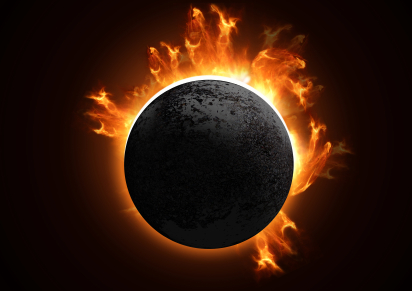
A solar eclipse is when the Moon comes in between the Sun and the Earth, creating a shadow a few hundred kilometres wide on the Earth.


- How big exactly is the Sun?

The Sun is a small to medium-sized star 1, 392, 000 km (0.86 million miles) in diameter. It weighs just under 2000 trillion trillion tonnes.

- What is the Sun's crown?

The Sun's crown is its corona, its glowing white hot atmosphere seen only as a halo when the rest of the Sun's disc is blotted out by the Moon in a solar eclipse.

- How hot is the Sun?

The surface of the Sun is a phenomenal 6000 degree celcius and would melt absolutely anything. But its core is thousands of times hotter at over 16 million degree celcius!


- What makes the Sun burn?

The Sun get its heat from nuclear fusion. Huge pressures deep inside the Sun force the nuclei (cores) of hydrogen atoms to fuse together to make helium atoms, releasing huge amounts of nuclear energy.

- How old is the Sun?

The Sun is a middle-aged star and probably formed about five billion years ago. It will probably burn for another five billion years and then die in a blaze so bright that the Earth will be scorched right out of existence.

- What is the solar wind?

The solar wind is the stream of radioactive particles constantly blowing out from the Sun at hundreds of kilometres per second. (The Earth is protected from the solar wind by its magnetic field, but at the poles, the solar wind interacts with the Earth's atmosphere to create the aurora borealis or northern lights.) 

- What are solar flares?

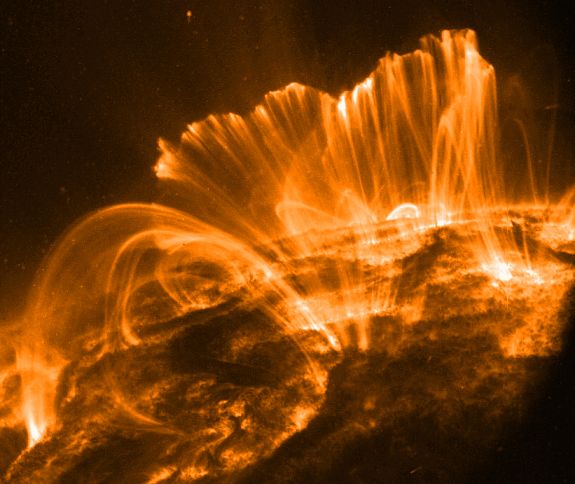
Flares are eruptions from the Sun's surface that fountain into space with the energy of one million atom bombs for about five minutes. (They are similar to solar prominences, the giant flame-like tongues of hot hydrogen that loop 100 000km/60000 miles into space.)


- Sunpots

Sunpots are dark blotches seen on the Sun's surface. They are thousands of kilometres across, amd usually occur in pairs. They are dark as they are slightly less hot than the rest of the surface. As the Sun rotates, they slowly cross its face - in about 37 days at the equator and 26 days at the Poles. The average number of spots seems to reach the maximum every 11 years, and many scientists believe that these sunspot maximums are linked to periods of stormier weather on the Earth.

- Parts of the Sun
Now, let watch an interesting documentary on the formation of the Sun. Enjoy!

What is really Moon (Erm......)

So do you know how does the Moon form?

The Moon is the Earth's natural satellite which has circled around it for at least four billion years. It is actually a rocky ball about a quarter of the Earth's size and is held in its orbit by mutual gravitational attraction. Scientists believed that the Monn formed when early in the Earth's history, a planet smashed into it. The impact was so great and tremendous that nothing was left of the planet but a few hot splashes thrown back up into space. Within a day of the smash, these splashes had been drawn together by gravity to form the Moon.

- Who was the first man on the Moon?

The first men on the Moon were Neil Armstrong and Buzz Aldrin of the US Apollo 11 mission who landed on the Moon on 21 July 1969. (As Neil Armstrong once said, "This a small step for a man, a giant leap for mankind.")

- What are the Moon's seas?

The large dark pitches visible on the Moon's surface are called seas, but in fact they are not seas at all. They are huge plains formed by lava flowing from volcanoes that erupted early on in the Moon's history.

- How long is a Moon month?

It takes the Moon approximately 27.3 days to circle the Earth, but 29.53 days from one full moon to the next as the Earth moves as well. A lunar month is the 29.53 days cycle. Calendar months are entirely artificial.

- What is a lunar eclipse?

As the Moon revolves round the Earth, sometimes it passes right into the Earth's shadow, where sunlight is blocked off. This is a lunar eclipse. So if you look at the Moon during this period of time, you will see the dark disc of the Earth's shadow creeping across the Moon.

- What exactly is moonlight?

The Moon is by far the brightest object in the night sky. However, it does not give off its own light. Hence, it simply reflects off the Sun light to produce moonlight.

- What is inside the Moon?
  • The Moon's surface is covered with a fine layer of dust.
  • The surface of the Moon is pitted with impact craters, obliterated in part by giant ancient lava flows called seas
  • The Moon's mantle is now very cool as compared to the Earth's.
  • The Moon's outer core is probably solid metal.
  • The Moon has an inner core of metal, very much smaller in relation to its size than the Earth's.
  • The Moon has a crust of solid rock thinner than the Earth's - up to 150 km (90 miles) thick on the side away from the Earth.
 - Harvest Moon

The harvest moon is the full moon nearest to the autumnal equinox (when night and day are of equal length). This moon hangs bright above the eastern horizon for several evenings, providing a good light for harvesters.

 - Why does the sea have tides?

The Moon's gravity draws the oceans into an oval around the Earth, creating a bulge of water on each side of the world. These bulges stay beneath the Moon as the Earth spins around and seem to run around the world, making the tide rise and fall as they pass.

- Phases of the Moon:


Now, let watch a video on the formation of the Moon:

How did the Earth begin? (WOW......!)

So do you really know how did our mother Earth form? Or why did it form?

- Formation of Earth

Around four and a half billion years ago, neither the Earth nor any of the other planets existed. There was just this vast dark very hit cloud of gas and dust swirling around the newly formed Sun. Gradually, the cloud cooled down and the gas began to condense into billions of water droplets. Slowly, these droplets then were pulled together into clumps by their own gravity - and they were carried on clumping until all the planets, including Earth, were formed. But it took about another half a billion years before the Earth had cooled enough to form a solid crust with an atmosphere around it.
- Process of the formation of the Earth

As the Earth orbits the Sun, the hemisphere of the planet which faces the Sun experiences summer while the hemisphere facing away from the Sun experiences winter.

- How long exactly is an Earth day?

An Earth day is the time when the Earth takes to rotate on its axis once. The stars come back to the same place in the sky every 23 hours 56 minutes 4.09 seconds (the sidereal day). Our day (the solar day) is 24 hours as the Earth is moving round the Sun and it must turn an extra 1 degree for the Sun to return to the same place in the sky.

- Why does the Earth spin?

The Earth spins as it is falling around the Sun. As the Earth hurtles round the Sun, the Sun's gravity keeps it spinning, just as the Earth's gravity keeps a ball rolling down hill. 

- What is the Earth made of?

The Earth has a core of iron and nickel, and a rocky crust which is made mostly of oxygen and silicon. In between is the soft hot mantle of metal silicates, sulphides and oxides.

- How big exactly is the Earth?

Satellite measurements show it is 40,024 km (24,870 miles) around the equator and 12,578 km (7,927 miles) across. The diameter at the poles is slightly less, by 43 km (26.7 miles).

- Who was Copernicus?

In the 1500s, most people thought that the Earth was fixed at the centre of the universe, with the Sun and the stars revolving around it. However, Nicolaus Copernicus (1473 - 1543) was the polish astronomer who first suggested that the Earth was actually revolving around the Sun and not the other way round.

Here, let watch an interesting video on the birth of the Earth. Enjoy!

Astrology VS Astronomy

After reading about the instruments used in Astronomy, I think you might be interested to know more about another topic which seems to be confused by most people with Astronomy. This term is Astrology (this might be your first time hearing this word, right?).

The word, Astrology, actually comes from the Greek word astron meaning "star" and logy meaning "the science". Astrology is a group of systems, traditions, and beliefs which hold that the relative positions of celestial bodies and related details can provide information about personality, human affairs, and other terrestrial matters. A practitioner of astrology is called an astrologer.

Since Babylonian times, people staring at the night sky were convinced that the regular motions of the heavens were indications of some great cosmic purpose. Priests and philosophers all believed that if they could map the stars and their movements, they could decode these stars and understand the patterns that had an effect on past and future events.

However, there is no evidence to support their belief that stars and planets have any effect on our personalities or our destinies. Astronomers now thnik Astrology is just superstition. However, its original noble motives should not be forgetten. For most of the so-called "Dark Ages", when all pure science was in deep hibernation and the desire to know about the future that kept the science of Astronomy alive.

- Rulership over organs

Until the discoveries of modern medicine, ancient people believed that the body was governed by four main different types of essence which were called "humours". An imbalance in these humours would result in illnesses. Each of the 12 signs of the horoscopes had special links with each of the hmours and with parts of the human body. One example is for a headache due to the moisture in the head (a cold), treatment would be with a drying agent - some plant ruled by the Sun or an "Earth sign", like Virgo -when a New Moon was well placed towards the sign of Aries, which ruled the head.

- Perpetual Calendar

In this calendar, the names for the days of the week show traces of astrological belief - for example, Sunday is the Sun's day, and Monday is the Moon's day. This simple perpetual calendar, which contains small planetary signs next to each day, shows the day of the week for any given date. The user can find out the day by turning the inner dial to a given month or date and reading off the information.


- Examples of zodiacs in Astrology

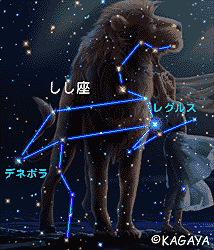
These 19th-century French constellation cards show each individual star marked with a hole through which light shines. Astrologically, each zodiacal sign has its own properties and its own friendships and enemies within the zodiacal circle. Each sign is also ruled by a planet, which similarly has its own properties, friendships, and enemies. So, for example, a person born while the Sun is passing through Leo is supposed to be kindly, like a lion. 

Scorpio, the Scorpion

Most of the constellations are now known by the Latinized versions of their original Greek names. This card shows Scorpius, or Scorpio. This is the sign "through which" the Sun passes between late October and late November. Astrologers believe that people born during this time of year are intuitive, yet secretive, like a scorpion scuttling under a rock.


Cancer, the Crab

Cancer is supposed to be a home-body, like a crab in its shell. These hand-painted cards are collectively known as Urania's Mirror - Urania is the name of the muse of astronomy. By holding the cards up to the light, it is possible to learn the shapes and relative brightness of the stars in each constellation.

References: