Instruments used in Astronomy (COOL......!)

Now that you have learnt the history of ancient Astronomy, I think it is always good for you to know the ancient instruments used in Astronomy. With all the tools of modern technology, it is something hard to imagine how people performed simple functions such as telling the time or knowing where they were on the Earth before the great invention of the clock, maps, or navigational satellites. In ancient times, the only tools available were those provided by the nature.
The astronomical facts of the relatively regular interval of the day, the constancy of the movements of the fixed stars, and the assumption of certain theories, such as a spherical Earth, allowed people to measure their lives. By calculating the height of the Sun or certain stars, the ancient Greek began to understand the shape and size of the Earth. In this way, they were able to determine their latitude. By plotting coordinates against a globe, they could fix their position on the Earth's surface. In addition, by setting up carefully measured markers, or gnomons, they could begin to calculate the time of the day.

* Interesting facts......!
- Measuring the size of the Earth

About 230 BC, Eratosthenes (c. 270 - 190 BC) estimated the size of the Earth by using the Sun. But how......? He discovered that the Sun was directly above his head at Syene in Upper Eypt at noon on the summer solstice. In Alexandra, directly north, the Sun was actually about 7 degrees from its highest point (the zenith) at the summer solstice. Since Eratosthenes knew that the Earth was spherical (360 degrees in circumference), the distance between the two towns should be 7/360 ths of the Earth's circumference.

- Ancient Sundial

Very early on, people realized that they could keep time by the Sun. Simple sundials like this allowed traveller or merchant to know the local time for several different towns during a journey. The altitude of the Sun was measured through the sight holes in the bow and stern of the "little ship". When the cursor on the ship's mast was set to the correct latitude, the plump bob would fall on the proper time.

- How a sundial works?

As the Sun travels across the sky, the shadow which it casts changes in direction and length. A sundial works by setting a gnomon, or "indicator", so that the shadow which the Sun casts at noon falls due north/south along a meridian. (A meridian is an imaginary line running from pole to pole and another for it is a line of longitude.)

The hours can then be divided before and after the noon mark. Hence, the terms "a.m." and "p.m." for morning and night actually originated from the Latin words meaning before and after the Sun passes the north/south meridian. So "a.m." actually refers to "ante meridiem" and "p.m." refers to "post meridiem"!

- Cruciform sundial
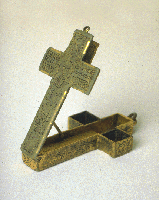
Travelling Christian pilgrims often worried that any ornament might be considered a symbol of vanity. They solved this problem by incorporating religious symbolism into their sundials. This dial, which is shaped in the form of a cross, provided the means for telling the time in a number of English and French towns.
- Celestial Globe

The celestial globe records the figures and stars of all the constellations against a grid of lines representing longitude and latitude. During the 17th and 18th centuries, all ships of the Dutch East India Company (E.I.C) were given a matching pair of globes - terrestial and celestial. Calculations could be made by comparing the coordinates on the two different globes. In practice, however, most navigators seemed to be using flat sea-charts to plot their journeys instead of celestial globes.

- Backstaff

The backstaff allowed a navigator to measure the height of the Sun without having to stare directly at it. The navigator held the instrument so that the shadow cast by the shadow vane would fall directly on to the horizon vane. Moving the sight vane, the navigator lined it up so he could see the horizon through the sight vane and the horizon vane. By adding together the angles of the sight and shadow vanes, the navigator could calculate the altitude of the Sun, from which he could determine the precise latitude of his ship.


Image source:

More about Stonehenge

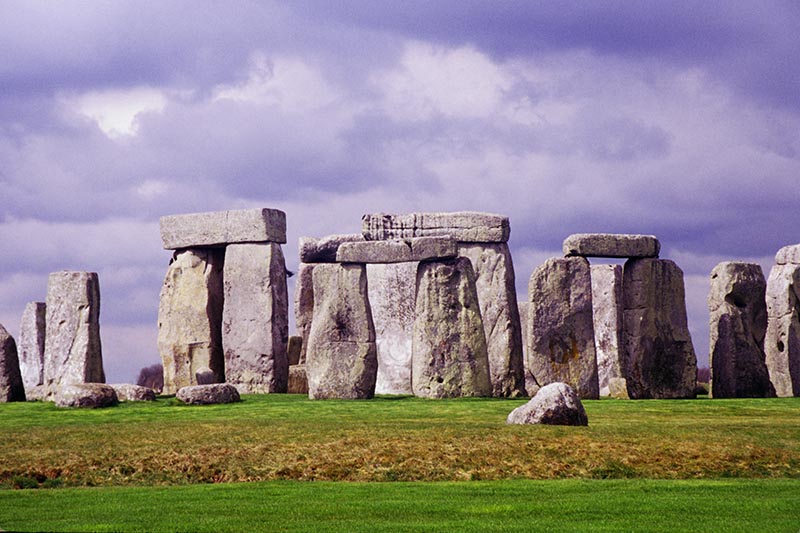
Stonehenge, constructed between 3100-2000 BCE on England's Salisbury Plain, may have been a Stoneage astronomical site (observatory is too strong a word), at least in part. Certainly the alignment of the "heelstone" with the rising Sun on Midsummer's Day (June 21, the Summer Solstice) represents a true astronomical alignment, and many other Megalithic sites have similar alignments. In Stonehenge Decoded, astronomer Gerald Hawkins argued that there exist a large number of astronomical alignments, though further study suggests that many of these are fortuitous.
Cosmologist Fred Hoyle has suggested that Stonehenge may have been used to keep track of the solar-lunar eclipse cycle. Far outside the still partially standing ring of Sarsen Stones is a ring of 56 holes, known as the Aubry holes. Hoyle has noted that movement of a marking stone by 3 positions each time the Sun rose over the heelstone (or by one position three times yearly) would complete a circle in 18.67 years -- approximately the period for the "nodes", the intercepts of the lunar and solar paths in the sky, to complete a cycle. Certainly ritual use of Stonehenge would have been more important that its astronomical functions and much of this interpretation must remain speculation.

- Recording Sun's movements

Even though the precise significance of the standing stones at Stonehenge remains the subject of debate, it is clear from the arrangement of the stones that were erected by pre-historic people specifically to record certain celestial events, such as the summer and winter solstices and the spring and autumnal equinoxes. Although Stonehenge is the best known of the ancient megalithic monuments (those made of stone in pre-historic times), the sheer number of similar sites throughout the world underlines how many pre-historic people placed an enormous importance on recording the motions of the Sun and the Moon.


- Parts of the Stonehenge

As seen in the above diagram, there is an avenue leading to the centre of the Stonehenge. Along the avenue, there is also heel stone which marks the original approach to the Stonehenge. After passing the heel stones, you will see slaughter stone which actually forms a ceremonial doorway for the Stonehenge. Around the Stonehenge, there are also some station stones with aubrey holes which are round pits that were part of the earliest structure. In addition, there is a barrow in it and a circle of Sarsen stones with lintels in the centre of the Stonehenge. In the circle, there is an altar stone which is found in the middle of it.


References:

History of Astronomy (Oh Yes!)

As Astronomy is the oldest of the sciences, it has a long history which evolves from one stage of life to another.
In ancient times, early cultures identified celestial objects with gods and spirits. They related these objects (and their movements) to phenomena such as rain, drought, seasons, and tides. It is generally believed that the first "professional" astronomers were priests (such as the Magi), and that their understanding of the "heavens" was seen as "divine", hence astronomy's ancient connection to what is now called astrology. Ancient structures with possibly astronomical alignments (such as Stonehenge) probably fulfilled both astronomical and religious functions.

In the ancient times, calendars of the world would have usually been set by the Sun and Moon (measuring the day, month and year) and were of importance to agricultural societies, in which the harvest depended on planting at the correct time of year. The most common modern calendar is based on the Roman calendar, which divided the year into twelve months of alternating thirty and thirty-one days apiece. In 46 BC Julius Caesar instigated calendar reform and adopted a calendar based upon the 365 1/4 day year length originally proposed by 4th century BC Greek astronomer Callippus.

- NAMING THE PLANETS

The spread of knowledge tends to follow the two routes of trade and war. As great empires were expanding, they eventually brought their gods, customs, and learning with them. The earliest civilisation believed that the stars and planets were actually ruled by gods. How amazing!

One example is the Babylonians named each planet after the god which they believed had most in common with that planet's characteristics. In addition, the Greeks and the Romans soon adopted this Babylonian system, replacing the names of the planets with those of their gods. Hence, all planet names can be traced directly to the Babylonian planet-gods such as: Nergal has become Mars, and Marduk has become the god Jupiter. 

- Babylonian records

The earliest astronomical records are in the form of clay tablets from ancient Mesopotamia, the "land between the rivers" Tigris and Euphrates, where the ancient kingdoms of Sumer, Assyria, and Babylonia were located. A form of writing known as cuneiform emerged among the Sumerians around 3500-3000 BC. Our knowledge of Sumerian astronomy is indirect, via the earliest Babylonian star catalogues dating from about 1200 BC. The fact that many star names appear in Sumerian suggests a continuity reaching into the Early Bronze Age. Astral theology, which gave planetary gods an important role in Mesopotamian mythology and religion, began with the Sumerians. They also used a sexagesimal (base 60) place-value number system, which simplified the task of recording very large and very small numbers. The modern practice of dividing a circle into 360 degrees, of 60 minutes each, began with the Sumerians.
Classical sources frequently use the term Chaldeans for the astronomers of Mesopotamia, who were, in reality, priest-scribes specializing in astrology and other forms of divination.
The first evidence of recognition that astronomical phenomena are periodic and of the application of mathematics to their prediction is Babylonian. Tablets dating back to the Old Babylonian period [disambiguation needed] document the application of mathematics to the variation in the length of daylight over a solar year. Centuries of Babylonian observations of celestial phenomena are recorded in the series of cuneiform tablets known as the Enūma Anu Enlil. The oldest significant astronomical text that we possess is Tablet 63 of the Enūma Anu Enlil, the Venus tablet of Ammi-saduqa, which lists the first and last visible risings of Venus over a period of about 21 years and is the earliest evidence that the phenomena of a planet were recognized as periodic. The MUL.APIN, contains catalogues of stars and constellations as well as schemes for predicting heliacal risings and the settings of the planets, lengths of daylight measured by a water-clock, gnomon, shadows, and intercalations. The Babylonian GU text arranges stars in 'strings' that lie along declination circles and thus measure right-ascensions or time-intervals, and also employs the stars of the zenith, which are also separated by given right-ascensional differences.
A significant increase in the quality and frequency of Babylonian observations appeared during the reign of Nabonassar (747-733 BC). The systematic records of ominous phenomena in astronomical diaries that began at this time allowed for the discovery of a repeating 18-year cycle of lunar eclipses, for example. The Greek astronomer Ptolemy later used Nabonassar's reign to fix the beginning of an era, since he felt that the earliest usable observations began at this time.

The last stages in the development of Babylonian astronomy took place during the time of the Seleucid Empire (323-60 BC). In the third century BC, astronomers began to use "goal-year texts" to predict the motions of the planets. These texts compiled records of past observations to find repeating occurrences of ominous phenomena for each planet. About the same time, or shortly afterwards, astronomers created mathematical models that allowed them to predict these phenomena directly, without consulting past records. A notable Babylonian astronomer from this time was Seleucus of Seleucia, who was a supporter of the heliocentric model.
Babylonian astronomy was the basis for much of what was done in Greek and Hellenistic astronomy, in classical Indian astronomy, in Sassanian Iran, in Byzantium, in Syria, in Islamic astronomy, in Central Asia, and in Western Europe.

Now, let's enjoy a video on ancient astronomy which will help you to understand better of the history of Astronomy

Video Title: Ancient Astronomy
URL: http://www.youtube.com/watch?v=H-5dwJwau1Y


References:

Ancient Astronomy (The Study of the Heavens)

The word, "Astronomy" comes from a combination of two Greek words: astron meaning "star" and nemein meaning "to name". Even though the beginnings of Astronomy go back thousands of years beofre the ancient Greeks began studying the stars, the science of Asstronomy has always been based on the similar priniciple of "naming the stars". 

Many of the names originated from the Greeks, since they were the FIRST Astronomers to make a systematic catalogue of all the stars they could see. (Isn't that interesting......!)

From here, we can see that astronomy is actually one of the oldest of the natural sciences, dating back to antiquity, with its origins in the religious, mythological, and astrological practices of pre-history: vestiges of these are still found in astrology, a discipline long interwoven with public and governmental astronomy, and not completely disentangled from it until a few centuries ago in the Western World.

In the early times, ancient astronomy used to be involved in observing the regular patterns of the motions of visible celestial objects, especially the Sun, Moon, stars and naked eye planets. An example of this early astronomy might involve a study of the changing position of the Sun along the horizon or the changing appearances of stars in the course of the year, which could be used to establish an agricultural or ritual calendar. In some cultures astronomical data was used for astrological prognostication.


In addition, a number of early civilisations remembered the relative positions of the stars by putting together groups that seemed to make patterns in the night sky. One of these might look like a curling river, so it was called Eridanus which is known as "the great river" in Greek. Another example will be the position of stars which look like a hunter with a bright belt and dagger. This is position of stars is actually called Orion, the hunter.

* Interesting facts......!
Do you know that the earliest astronomers were actually shepherds who watched the heavens for signs of the changing seasons! Those clear nights would have given them the opportunity to recognize familiar patterns and movements of the brightest heavenly bodies.
 
Ancient astronomers were able to differentiate between stars and planets, as stars remain relatively fixed over the centuries while planets will move an appreciable amount during a comparatively short time.

In ancient times, early astronomers realised that these repeating motions in the cyclic motion of the Sun, the Moon and the stars could actually be used to fashion the sky into a "living" clock (to tell the passage of the hours of the day or night) and a calendar (to mark the progression of the seasons). Ancient monuments, such as Stonehenge in UK and the pyramids of the Maya in Central America, provide evidence that the basic components of observational astronomy have been known for at least 6000 years! Ancient structures with possibly astronomical alignments probably fulfilled both astronomical and religious functions.

With only a few exceptions, almost all civilisations have believed that the steady movements of the sky were some sort of signal of greater plan to them.

One example is the phenomenon of a solar eclipse which was believed by some ancient civilisations that it was actually a dragon eating the Sun. Hence, some ancient people would make great noise to frighten the dragon away. Thus, we can see that different civilisations actually have different beliefs of the movements in sky.

Fun time......!
After reading my posts on Astronomy, I'm sure you have an idea of what is Astronomy. To deepen your understanding, let learn it in an interesting way through games & crossword puzzles!

To play the game, "Make-A-Planet", please click the link below:

 
References:

Definition of Astronomy (AWESOME!)

So you may be thinking in your mind right now that "What is really astronomy?", I mean, you may think that it is a really complicated science? Well don't worry, you will explore the world of Astronomy in this website and this will enhance your understanding of it. Also, it may inculcate this interest of Astronomy in you.


You see, Astronomy is not only about planets, universes, stars and comets, it is more than just a branch of science as it ranges from ancient astronomy (How ancient people study Astronomy), the inner planets, outer planets, giant planets, the birth & death of star, black holes, galaxies, history of universe and instruments used in the study of Astronomy.


So before you even embark on the learning journey of Astronomy in this blog, I think it is best for you to know what is Astronomy.
Astronomy can be defined like in many ways:
  • Some say that it is the scientific study of the universe and the objects in it, including stars, planets, nebulae, and galaxies. Here astronomy deals with the position, size, motion, composition, energy, and evolution of celestial objects. In addition, astronomers analyze not only visible light but also radio waves, x-rays, and other ranges of radiation that come from sources outside the Earth’s atmosphere.

  • Other says that Astronomy is the science which investigates all the matter-energy in the universe: its distribution, composition, physical states, movements, and evolution.
* Distribution: The position, arrangement or frequency of matter (or energy) over an area or throughout space.


Movements: Any condition related to the positional change of matter in space or on a coordinate grid.

Rotation: Period of time a body takes to complete one spin about its axis.

Revolution: Period of time a less massive body takes to complete one orbit around a more massive object

Physical States: The conditions which permit matter to be found as a solid, liquid, gas or plasma.

Solid: Matter with a definite shape, volume, and some fundamental strength.


Liquid: Characterized by free movement of the constiuent molecules among themselves, but without the tendency to separate from one another.

Gas: A fluid that has neither independent shape nor volume, but tends to expand indefinitely.

Plasma: A gas which is ionized which means that it is not electrically neutral. This gas is composed of ions and electrons. The ions (atoms or molecules) which compose the substance have an excess or deficiency of electrons (negative charge) in comparison to the number of protons (positive charge) that they contain.

Composition: The qualitative and quantitative chemical makeup of matter.

Qualitative Example: The sun is composed of hydrogen and helium. Components are merely identified.

Quantitative Example: The sun by volume is composed of 95% hydrogen and 5% helium, but by mass it is composed of 78% hydrogen, 20% helium, and 2% heavier metals. Components are identified by amounts in a numerical fashion.

Evolution: The process of change of the universe in a certain direction. The Steady State (no longer accepted), Big Bang, and Oscillating Universe detail evolutionary sequences for the universe.

Steady State: The universe was always here, always will be here, is infinitely expanding, and appears the same from all locations. Hydrogen is created in the voids between galaxies.

Big Bang: The universe started with a blast and will expand forever.

Oscillating Universe: The universe started with the big bang, but possesses enough mass (gravity) to halt the expansion so that it will one day collapse upon itself.

As you can see, Astronomy is a wide topic and no one really know what is it as people have different definitions of it (that's why it is so interesting!). But in general, Astronomy is a fascinating science and a study of everything that is in outer space including stars, planets, constellations, comets, the solar system, etc.
 
Here is a video which is recommended by me for you to watch if you want to know more about the introduction of Astronomy: (Enjoy)
 
Video Title: Astronomy Online Course - UniversalClass
URL: http://www.youtube.com/watch?v=ewreKSiaW1I


So I would say that:

Astronomy is the study of everything in outer space


As you know, people who study outer space are called astronomers. So, if you are very interested in this study of Astronomy in the study of outer space, you could consider yourself an amateur astronomer.
So anything that's in space and can be studied is actually a part of astronomy. When you look up at the night sky and wonder about all those stars that you see, that's where astronomy starts at.

Astronomy, like every other science, begins with a curiosity about the world around you. So wait no more, continue to read my blog to uncover the fascinating world of Astronomy ahead of you......!

Photo of the day!

Here, you will see all sorts of photos, ranging from breath-taking sceneries to sumptious food. As the saying goes, "A picture is equal to a thousand words", hope you will enjoy......!

Today 's photo (1-3-10):


Today 's photo (2-3-10):


Today 's photo (3-3-10):


Today 's photo (4-3-10):

Online Learning (2 March) Task B(ii): Intrapersonal

b. Who would you want to be friends with in the novel? Explain.

If I were in the novel, I would definitely befriend with Atticus as I really admire his courage in the novel. I feel that he is very brave, smart and courageous which can be seen from his decision to defend Tom Robinson in the trail although everyone disapproved he. In addition, he also believed in equality and justice as he felt that the blacks should be treated equally as the whites. He is also fair to everyone despite the difference in skin colour.

Also, I would make friends with Atticus as I feel that he is quite hospitable, friendly and caring. This can be seen when Walter Cunningham went to the Finch house, he welcomed him. Also, Atticus is approachable to me as he is very caring to others and showered love to his children. I feel that he is approachable as he is not arrogant and is quite humble. This can be seen when he did not show any arrogance when Heck Tate said that he was actually the best shot in Maycomb.

In my opinion, Atticus is sympathetic and determined as a lawyer as he was willing to go against the social convention to defend Tom Robinson in the trail. He also had physical courage which was showed when he went forward and shot Old Tom. In addition, I believe that I can also learn a lot from his values and beliefs if I were his friend. Hence, I would definitely befriend with Atticus.