Mayans Astronomy (Continued)

What the Mayans Were interested in?


The Mayans more interested in the:
1) Sun

The sun was associated with Tonatiuh , a red eagle with a large and all-seeing eye. The Mayans managed to calculate the times when the Sun would rise and set. They even determined the length of the solar year to be 365 days. A tropical year is actually 365.2422 days long! How close!


2. The Moon

The Mayans were also interested in the moon. It was represented by a female deity. A waxing (growing) moon resembles a beautiful, ideal woman, while a waning (shrinking) moon was considered to be an old female deity who ruled over childbirth. Around 300 C.E., the Mayans calculated the interval between full moons (lunation). A Mayan astronomer calculated that there was an average lunation of 29.53 days while in Palenque, Mayans calculated that there was an average lunation of 29.53086 days. The actual average lunation is 29.53059 days. The difference is as small as 0.00059 days!

3. Venus

Venus was considered to be connected with the major deity Quetzalcoatl. Quetzalcoatl was said to be an essential god when creating mankind. Venus was also known as “Great Star”. The priest-astronomers determined that it took 584 days for Venus to orbit round the Sun, which was close to the actual period of 583.92 days. It is amazing how the Mayans managed to find out about other planets despite the huge distance between Earth and Venus.

4. Star clusters

Certain star clusters and constellations also held special meaning for the Maya. An example would be the Pleiades star cluster. When it appears in the morning sky around planting time, in late April, the Mayans used it as an indication to start preparing for the planting season. Since they could predict the rising of the Pleiades in connection to the appearance of other constellations on the horizon, they always know when to start preparing.

- Problems with calculations
However, do you know that actually small errors like 0.00059 days off in calculations can cause a calendar to be completely not accurate. A possible effect is that the calendar can be a month off every hundred years. But the Mayans continually update their records and predictions so that their calendar remains accurate throughout the generations.

Mayans Astronomy Introduction (Finally......!)

Hi, all astronomy fans, good to see all of you back, now let us start on the Mayan culture Astronomy......!

Introduction:
Do you know that in the Mayans culture, astronomy was actually done by priests or "ilhuica tlamatilizmatini" ("the wise man who studies heaven"). All the observations were done, only using special buildings as reference points. The Mayans paired certain celestial bodies with a god and thus regard celestial events as an indication of their communication with these gods. Mayans also use to constellations or planets in the sky to indicate the planting season. This ensures that the Mayans will not starve. SMART!


So how did the Mayans exactly make observations in the sky? A common method called the Zenith passage of the Sun is used. Twice a year at noon the sun stands directly overhead in the tropics. The path in which the Sun takes then is called the Zenith passage. Mayans would place a column with exact vertical alignment to the Sun onto the ground or on the roof. When the Sun passes through the Zenith passage above this column, no shadows would be formed. Some Mayans also stay in Vertical Sighting, which are holes in the ground to observe the sky.

Vertical Zenith Sighting Tube

Calculation


After observing, one definitely needs to calculate some figures. On the whole, these calculations were simply done by counting, for instance, the number of lunar revolutions in a certain time period. For more complex calculations, however, mathematics was used.

M.A.Y.A.N.S Simplified Mayans Astronomy Intro Video


Hi, all astronomers! To start on the interesting Mayans astronomy, I had created a short introductory video for you to have at least a idea of what the Mayans Astronomy was like. This video was made with iMovie and this was aimed to give a short preview of the Astronomy in the Mayans times and how it worked. We wanted to make the video as informal as possible, giving it a more "movie-trailer" like effect to further enhance the attractiveness of our project. We got all of the pictures from the internet and added many special effects and even some music! Hope you enjoy our video!

M.A.Y.A.N.S Simplified project product outcome - something new!

Product outcome
Project website ( product outcome)

What a relief! Our project website is finally done! What has seemed like an impossible feat has now become possible. The website now consist of a main page, with our introductory video right in the middle of screen, followed by 4 links at the bottom. Namely :Quiz, Info, Blog, and credits.


I am quite satisfied with the outcome, as i have been working on this product for more than a month, and now, with every thing coming together, the website has truly become educational and interactive ( the main aim of our website) . However, despite me being in a temporary state of euphoria, i still have to get back to work, as the website still has some minor bloopers (eg. spelling error and FTP errors).

Here are some screen shots of our website :

So, all astronomy fans, now let us embark on a new journey to the...... Mayans Astronomy! Ya!!!


Mars now frozen, but when did it have liquid water? (Part 1)

Once again, good to see all astronomy fans here hungry for more astronomy news, updates and interesting facts! Now today, I'm researching about the mysterious red planet - Mars......
As all of you should know, Mars is now frozen, with no single drop of liquid water as water is frozen solid. But there are still some evidences showing that there may have been liquid water on its surface when Mars was young, however, is this TRUE? 

For some contextual knowledge, the average temperature of this Red Planet is actually negative 55 degrees Celsius (-67 F)! So freezingly C...O....COOL! However, do you know that when the temperature rises, the highest recorded temperature is a balmy 20 degrees C (68 F)! During this period, this thick layer of ice turns directly into a gas, skipping the liquid phase entirely because of the low atmospheric pressure.

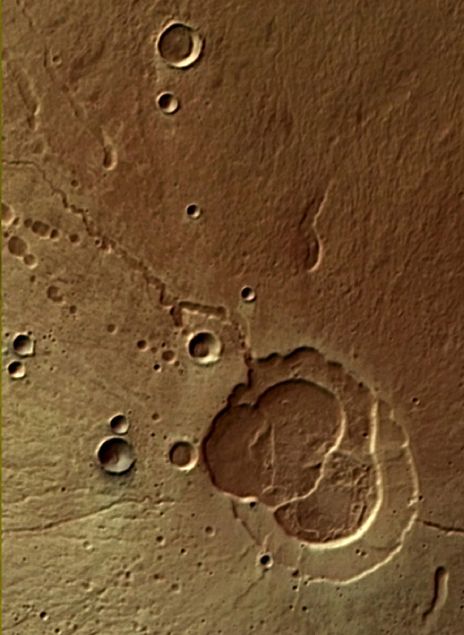
According to scientific research, Mars may have had a thicker atmosphere and liquid water on its surface between 3.5 and 4 billion years ago. Satellites orbiting Mars have also taken images of ancient ocean shorelines, river beds and canyons - which are evidences of the presence of flowing water. In addition, the chemistry of the martian soil also suggests that liquid water may have been present once on the surface. Then if this is true, then perhaps life could have emerged on Mars during this time in its history.


Many scientists think Mars was cold when it was young - cold enough so that surface water should have been frozen solid. One way around this problem is if the chemistry of the water was such that it could remain liquid at lower temperatures. On Earth, the salt in seawater prevents it from freezing at the same temperature as freshwater. For early Mars to be cold but still wet, however, the water would have had to be much saltier than seems likely.

However, there is still another possibility that Mars was actually warmer in the past than colder. At first glance, you may feel that this idea does not make any sense to you, however, think again. You see, the Sun was fainter back then, long ago, so the planet should have been even colder in the past and then gradually warmed up as the Sun grew brighter. But sunlight is not the only way to warm a planet, isn't it?


An atmosphere can also help keep conditions toasty. Okay, just look at Venus, thick greenhouse atmosphere has actually raised its average surface temperature to a searing 464 degrees Celsius (867 F)! So can you see the effects of greenhouse atmosphere on the warming of planet?

Think again, could Mars also once have had a greenhouse atmosphere that warmed the planet enough so it is able to keep water flowing across its surface in the past?

However, some scientists do not think this way. Professor Brian Toon of the University of Colorado had discussed the possibility of a warm and wet Mars at the recent NASA Astrobiology Science Conference in League City, Texas.

"We've spent 30 years on the greenhouse effect and no one has solved the problem in a credible way so far,” noted Professor Toon. “On the greenhouse problem, we're just drifting into deeper and deeper complexity."

Why does the greenhouse climate work so well to heat up Venus but not Mars? The thick clouds of Venus also bounce a lot of sunlight off into space, and that reflection is why we’re not able to see the surface of Venus in the visible light spectrum. One answer is that Venus is much closer to the Sun, so it receives substantially more sunlight than Mars does. According to Toon, another reason is that Mars is little. The lower gravity of a less massive world reduces the rate that air cools with altitude. On Earth this rate is about 10 degrees Kelvin per kilometer, but on Mars the rate is about half that.


“This makes it harder to get a greenhouse effect, giving you less ‘bang for the buck’ for your greenhouse gases,” Professor Toon said. “Mars is hard to warm up because it’s so small.”


Also, Professor Toon believes that, rather than a greenhouse atmosphere keeping Mars warm and wet, the canyons and river beds we see on Mars formed due to periodic asteroid and comet impacts. In this scenario, impacts would have filled the atmosphere with vaporized rock and ice and resulted in several years of rainfall and flooding that created the erosion features on Mars.


“We know the impacts occurred - we can see the craters there,” said Professor Toon. “It's pretty much impossible to avoid there being large amounts of water coming from them.”
 
 
So, as you can see, this is one explanation by Professor Toon on the formation of flowing water on the red planet, Mars. However, you may have different viewpoints and opinions than what you see in this post. So feel free to comment in the discussion forum. Also, you will see another explanation on the formation of flowing liquid water on Mars very soon....... Good Luck!
 

Image resources:

Online Learning (26th May) War Poetry Task 2

Task 2


Complete the template provided in Annex A, focusing on (1) Point of View; (2) Situation and Setting; (3) Language/Diction; and (4) Personal Response, and post your response to Task 2 on your blog. This template is based on John Lye’s ‘Critical Analysis of Poetry’, and you can make reference to this in Annex B when in doubt.

1. Point of View

In this poem, the speaker is an American soldier during the Vietnam War who wanted the war to stop and strongly against modern warfare. This can be seen in first stanza line 1 where the poet wrote “America did not foresee”. This shows that the speaker had felt angry and mad by the great impacts of ‘Agent Orange’ used by the Americans during the ever-lasting Vietnam War, resulting many generations to be affected. Perhaps, the speaker was an American soldier who had experienced the war before, hence, he was able to see the dire consequences of modern warfare on the innocent people.

In addition, in second stanza line 8, the poet wrote “Nefariously America led astray” which tells us that the speaker felt that all these consequences were caused by the Americans. The speaker felt that the actions of the Americans were brutal and inhumane as they had caused many deaths and harmed the younger generations. Also, the Americans wanted to win the Vietnam War badly and thus used the highly dangerous ‘Agent Orange’ on the Vietnamese, however, unfortunately, they were unable to foresee the consequences caused by the use of ‘Agent Orange’ themselves. This can be seen in first stanza line 3 where “expecting others (The Vietnamese) to pay a high price” but the price was just too high for Vietnam to pay. “All the deceit continues to spread”. The hatred and sadness of the Vietnamese would continue to spread to younger generations. Also, in first stanza line 4,"tolling on the innocent and unborn", this shows that innocent people were killed and harmed by the use of ‘Agent Orange’. Therefore, the Americans had to "think twice" as the ‘Agent Orange’ would not only affected the Vietnamese, but also would affect themselves, thus saying that this war would never end.


2. Situation and Setting
- Emotional: "Toll on the innocent and unborn."

As the poet talks about the negative impacts of war, he relates to the depression of the innocent people who were killed in the midst of war. In this sentence, emotional conflicts are conveyed through harsh words used such "toll".

“All the deceit continues to spread”

In addition, in this line, the poet felt that the Americans were too cruel and brutal to have used the ‘Agent Orange’ in the war and felt unfair for Vietnam to suffer this horrendous treatment. Also, strong emotional conflict is conveyed through diction with the use of harsh words such as ‘deceit’ which means hatred.


- Saddening: “Generations untold WILL pay”

This shows that the situation was very saddening and helplessness as the poet felt that the modern warfare used in the war would do no good but only cause more harm on the younger generations who would suffer a lot. Thus, this shows the sadness and cruelty of war on the innocent ones.

3. Language/Diction

- “Potpourri”

In first stanza line 2, the poet used “Potpourri” which means a mixture of materials or substances. Therefore, in this poem, ‘potpourri’ is used to refer to the large-scaled mixture of deaths caused as a result of war, thus showing the great impacts of warfare on the people.
- “Toll”

In first stanza line 5, the poet used “toll” which means a payment or price that people have to pay. However, in this poem, “toll on the innocent and unborn” is used to the sacrificial of innocent lives in the war. Also, this depicts the pessimistic view of war where people were all killed and hurt in the war. Thus, “toll” is used to refer to the sufferings and sacrificial of lives which the innocent people have to pay.


4. Personal Response

From this poem, ‘Rainbow Death’, I quite agree to the poet’s opinions that war is brutal, unjustified, harsh, and will only bring unhappiness, sufferings and cause deaths. In a war, as both sides all battled with each other to win, they will resort to anything that is able to defeat their enemy. However, this will only cause more harm to the innocent ones. In this poem, the Americans resorted to use the ‘Agent Orange’ which were gas attacks to defeat Vietnam in the war. As a result, Vietnam had to pay a huge price and even affected the younger generations. In addition, I agree with the poet that there are many sacrificial of lives in a war, hence, I believe that we have to think twice before starting a war and should not make the innocent younger generations from suffering as ‘war are not over when war are over’, meaning that war will cause dire consequences even if it have ended.

Online Learning 2 (26th May) War Poetry Task 1

- War Poetry


Rainbow Death

America did not foresee
Green, pink, purple and other colors death potpourri!
Expecting others to pay a high price.
Now thinking twice?
Toll on the innocent and unborn.


Omnipotent and disregarding who will mourn.
Reflective about all the illness, birth defects and prematurely dead.
All the deceit continues to spread.
Nefariously America led astray -
Generations untold WILL pay –
Execrable effects of agent orange spray!


Hubert Wilson

Task 1
Based on your understanding of the selected poem, perform extensive web research and write a report detailing the conflict represented in the poem(s) of your choice. Bear in mind that this piece of background information will allow your blog audience to further understand the poem as well as your analysis of the poem in Task 2.

Hubert Wilson
Ssgt USAF, 1968-1972

In this poem, 'Rainbow Death', the poet is Hubert Wilson who was a Vietnam War veteran served in the USAF security service during the Vietnam War (American against Vietnam).When he was a young man, together with a dozen or so intelligence school graduates, they prepped for about 14 months at Kelly AFB in San Antonio, Texas. They were then sent to Vietnam or other places in Southeast Asia in 1970 to fight for USA in the Vietnam War and eventually stayed there for about 18 years. During his times in the war, his heath had started to deteriorate greatly and suffered from Parkinsonian type tremors, severe headaches, progressive limb pains, however, the doctors were unable to diagnose his disease. Also, having limb pains, Hubert Wilson’s mobility had deteriorated and thus later caused him to retire as a soldier. Like his father, Hubert Wilson then began writing poems as his pastime and wrote many poems, mostly about war which he had experienced as a retired soldier, thus wrote one of his best and famous poems, ‘Rainbow Death’.

This poem, ‘Rainbow Death’, speaks of a modern day ingredient of warfare during the Vietnam War that has caused appalling death and suffering, not only to its intended victims - the Vietnamese people, but also the service personnel that used or even just came into contact with “Agent Orange”. Thus, this shows that in a war, both sides, no matter what, will get hurt and affect in one way or another, hence, there is no such thing as ‘Win-Win’ situation in a war.


As trench warfare was still not common during that time, both sides, especially the USA, had used ‘Agent Orange’ which is the code name for a herbicide and defoliant, highly contaminated with TCDD. It is used by the U.S. military in its Herbicidal Warfare program during the Vietnam War. During the war, about 4.8 million Vietnamese people were exposed to Agent Orange, resulting in a total number of 400,000 deaths and disabilities, with 500,000 children born with birth defects.

Thus, this poem shows the impacts of modern warfare (in this case, gas attack) are great and had killed many innocent lives and affected the younger generations. In the poem, stanza 2 line 10, “Generations untold WILL pay”, this shows that the use of modern warfare would cause innocent unborn babies suffer from birth defects and in this line, the word ‘WILL’ emphasises on the great impact that ‘Agent Orange’ would bring to mankind during the war.


This poem, ‘Rainbow Death’ by Hubert Wilson, is written to remind everyone in the world that "wars aren't over when the wars are over". Although this sentence may seem contradictory, it generally means that even though wars have seemed to have ended, the effects of the wars still remains and would cause further problems to mankind, thus showing the danger of modern warfare. The modern warfare will not only cause harm and killed the soldiers on the battlefield fighting bravely for their countries, but also affect the younger generations. Hence, Hubert Wilson’ s intention of writing this poem is to emphasize the impacts and danger caused by war and modern warfare, and also tell people to think clearly before starting a war.


Resources:

- http://www.warpoetry.co.uk/2010warpoetry.html#Rainbow